
No More Old White Men
Woke-ism and the demonization of men
Treign Up · November 27, 2023 · 9 min read

Originally sent to the Treign Up Tactics newsletter on November 27, 2023. References to “this newsletter” or “this podcast” mean that original edition.
For over a year now, we’ve been writing about a crisis unfolding, affecting boys and young men across our society. At the heart of this crisis are three critical factors: deprivation, disengagement, and distortion. The deprivation of strong, positive male role models and mentors has left a void in the lives of many young men. There’s a palpable disengagement, as boys find themselves increasingly alienated from traditional educational and social structures like the church that no longer resonate with their intrinsic nature. Most alarmingly, there’s a growing distortion about what it means to be a man. This distortion is fed by conflicting messages – from the often polarizing views of figures like Andrew Tate to the silence or ambiguity of traditional institutions like the church. And then, looming large is the demonization of men within certain narratives of modern wokeism and critical theory, painting men as the perennial oppressors, responsible for myriad societal ills. This article delves into the complex web of these factors, exploring how they contribute to the current landscape where the identity and role of men are increasingly questioned and critiqued.
No More Old White Men
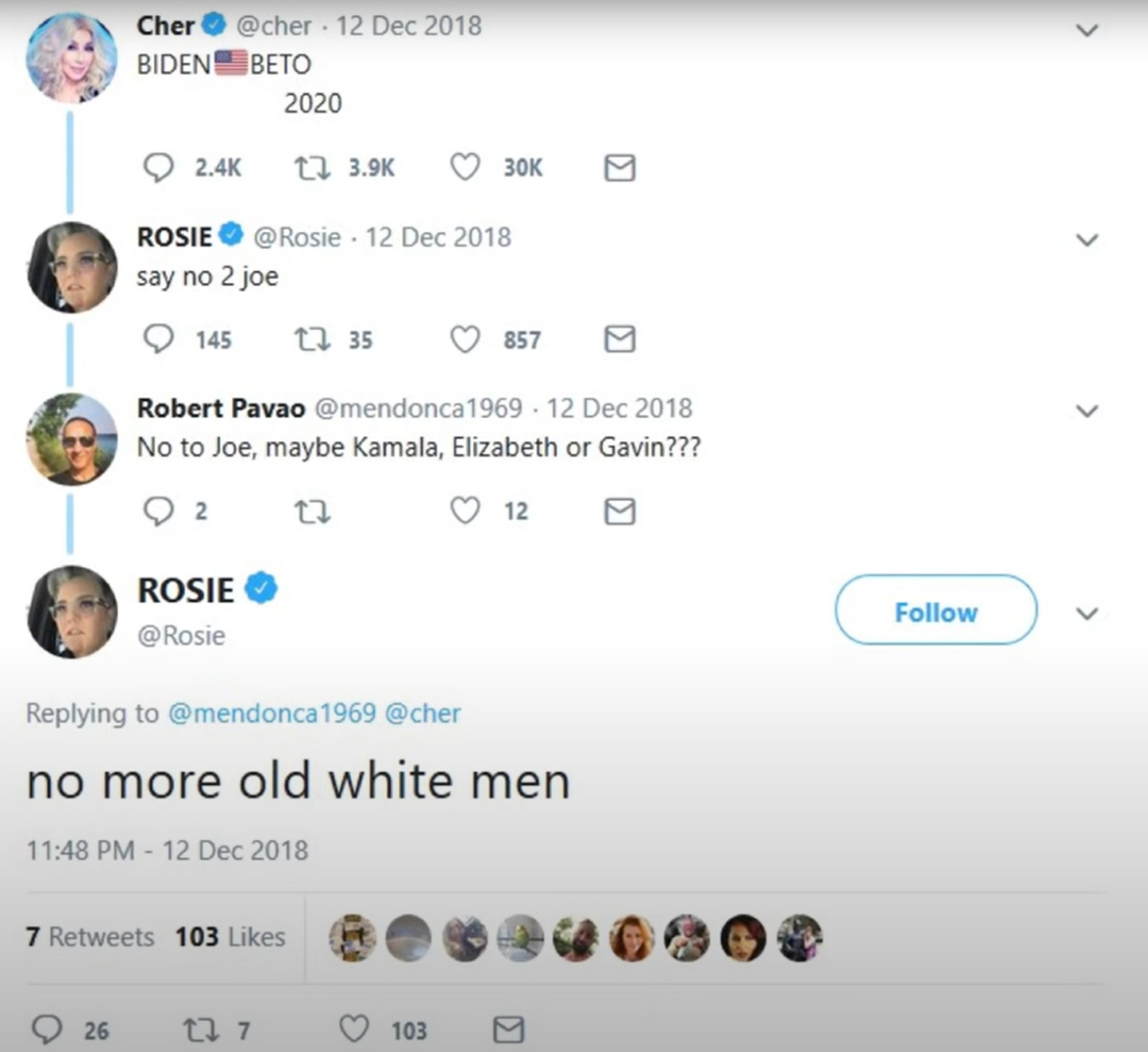
Could you imagine the opposite of this statement? NO MORE YOUNG BLACK WOMEN! There would be an uproar. Led primarily by our corrupted mass media who engage in narrative warfare every day. But this statement? More of the norm in this day and age. How did we get to this conclusion? It did not happen in a vacuum. It’s been slowly churning and maturing since the middle of almost a century. Let’s open up with everyone’s favorite - a good ole’ taxonomy.
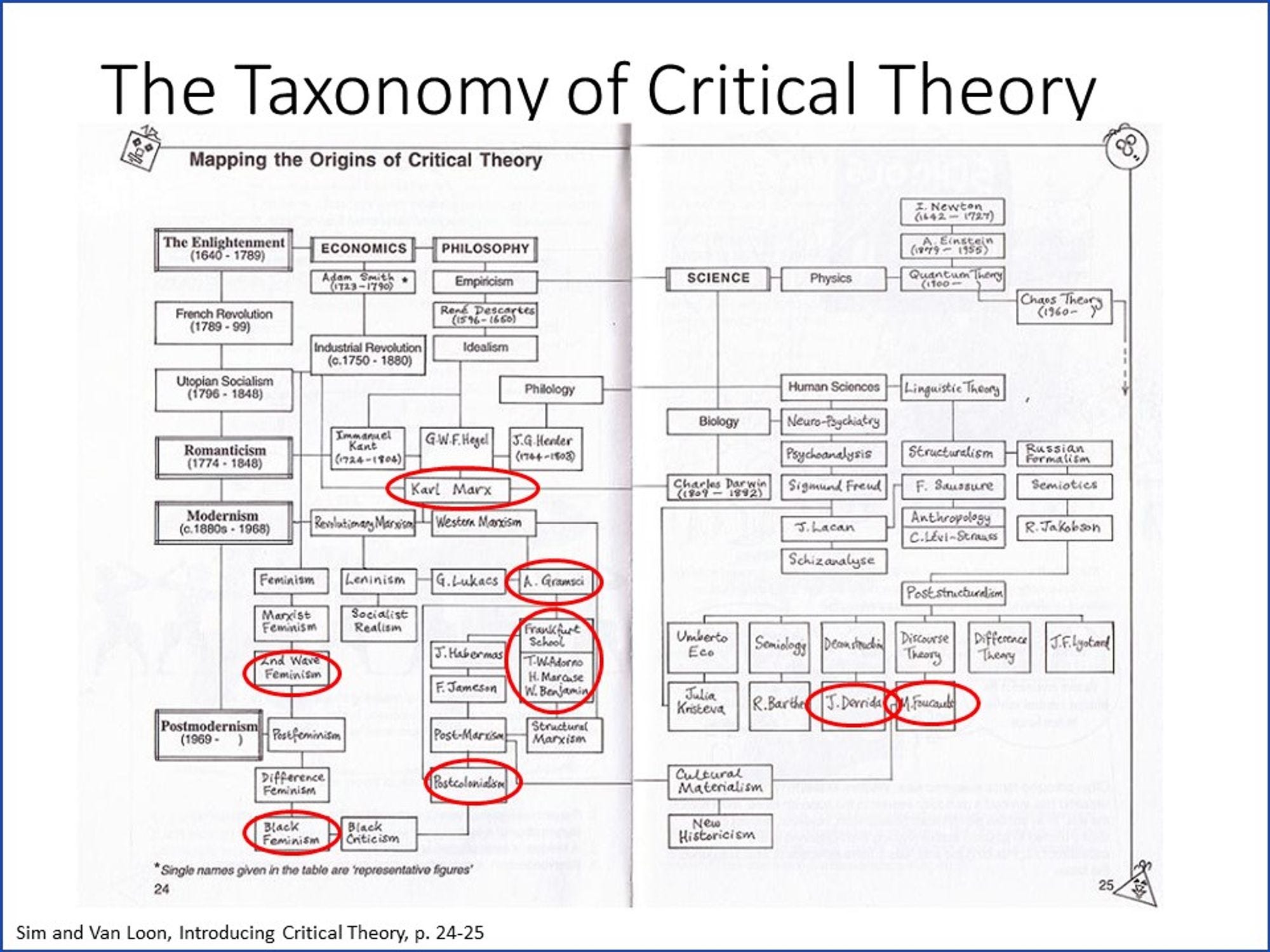
To start, I want to say that this topic is overly complex and a 3-page article on this does not do it justice. But I’ve trie my best to distill some of the most important elements. Let’s skip the first four ages and move to modernism.
Modernism is the period of time that “most” agree is between the 18th - 20th centuries that defined a mode of thinking and marked an era of profound transformation in society. It is characterized by a steadfast belief in rationality, scientific progress, and a linear view of history aiming toward continual improvement. It was an age where traditional structures and beliefs were critically examined and often upended in favor of reason and empirical evidence.
Postmodernism comes next. It stems from a number of intellectual circles that were tired of the promises of modernity. It emerged as a response to these modernist ideals, challenging the notion of objective truth and the grand narratives of progress. Rooted in skepticism, it questioned the universality of modernist principles, emphasizing instead the relative and constructed nature of knowledge and reality. Postmodernism brought a shift towards understanding society as a complex tapestry of diverse, often conflicting perspectives, underscoring the limitations of singular, overarching explanations of human experience and history.
This is where critical theory enters the world as it is intricately tied to the concepts of both of the above, but as we will see, carves its own distinct path.
Critical Theory
Critical Theory is a philosophical approach to culture, literature, and society that seeks to confront the social, historical, and ideological forces and structures that produce and constrain it. It stems mostly from the Frankfurt School in the 1920s and 30s and began to get more popular in the 1970s. It inherited from modernism a commitment to societal improvement and an emphasis on critiquing and understanding the structures that shape society. However, unlike modernism, which often celebrated the power of science and reason as tools for progress, critical theory was more skeptical. It focused on how these tools could be used to reinforce power structures and perpetuate social injustices. Some believe it paved the way for postmodern thought by challenging the idea of absolute truths and objective reality. It argued that our understanding of the world is influenced by social, economic, and historical contexts, thereby aligning with postmodernism's skepticism toward universal truths. Both critical theory and postmodernism emphasize the roles of power and social constructs in shaping human experience. Critical theory, in particular, focuses on critiquing and changing society, aiming to uncover and challenge the power dynamics within it, such as class, race, gender, and sexuality especially focusing on systems and institutions that perpetuate power imbalances, oppression, and inequality for the above categories.
It is also rooted in Marxist ideology. Marxism, a socio-economic and political framework derived from the ideas of Karl Marx, which analyzes class relations and societal conflict using a materialist interpretation of historical development. One of its primary concerns is how power circulates within society to produce and reproduce inequality and exploitation.
Since its inception, it has led to a number of other social theory categories (some of which are highlighted in the taxonomy above) such as:
Postcolonialism
Feminism
Black Feminism
Queer Theory
Gender Theory
Critical Race Theory
Other terminology that falls under this umbrella is:
Deconstructionism
Equity and Equality
Woke
Hegemony
False consciousness
Intersectionality
Discourse Analysis
Heteronormativity
Whiteness
Lived Experience
Internalized oppression
To be quite frank, the whole thing is a mess. There is very little consensus around these terms and umbrella theories and how they all align. In fact, it is the one go-to for those who have adopted these beliefs to ask those critical of it to define it. After a brave attempt, the host will say,
“HA! You don’t know what you’re talking about.”
But they themselves never provide their own definition. Anyways, there are a few main beliefs held by what some are calling “Contemporary Critical Theory.”
Premise 1: Social Binary
Society is divided by oppressed and oppressor groups along lines of race, class, gender, physical ability, etc…
Premise 2: Oppression Through Ideology
The dominant group maintains its power by imposing their ideology on everyone. What they call “hegemonic power”.
Oppression used to be defined as acts of cruelty, violence, and coercion. But they’ve added to this definition to refer to other ways the dominant social group imposes its values and norms on society to support its own power.
This is how a minority, such as old white men who make up 15% of population, are not considered minoritized, because they have the hegemonic power. This makes them part of the “oppressor” group
Premise 3: Lived Experience
Lived experience gives oppressed groups privileged or special access to truths about their oppression
“We must learn to privilege our own perspectives and those of other outsiders. We must learn to trust our own senses, feelings, and experiences, and to give them authority even or especially in the face of dominant accounts of social reality that claim universality.”
“The idea that objectivity is best reached only through rational thought is a specifically western and masculine way of thinking..”
The idea is that privileged groups are blinded by their privilege. They have both conscious and subconscious reasons for denying or ignoring the reality of oppression. In contrast, those that are oppressed can achieve a ‘Liberatory Consciousness’. They can “GET WOKE” or realize that dominant social norms are just attempts to justify oppression and thereby achieve a more realistic view of reality. They can literally, “awaken”. But if you don’t agree with this line of thinking, then you are just “internalizing oppression” failing to realize that it is just an exertion of power.
Premise 4: Social Justice
This is the primary goal - to eliminate all forms of social oppression.
A great example of this was in an Antifa rally where a Trump Supporter who was not being violent was struck on the head with a bike lock. The irony is that the person who attacked him was a college professor who taught ethics at the local university. It is a great example of how social justice can trump all other moral concerns when it sits at the pinnacle of the hierarchy.
Here are just some initial obvious issues that come to mind immediately for me:
This is perfect grounds for a system that promotes reverse racism. Also, who defines “oppression”?
Christianity is oppressive.
Lived experience outweighs objective evidence! It embraces bulverism instead of rational thought, evidence, and logic.
Social justice is the pinnacle purpose of our lives.

Sound crazy, right? And fairly antithetical to Christianity?
The problem is, like any great deception, there are kernels of truths that they have at their core. Here are a few:
Oppression is sinful and it is emphasized throughout the old and New Testaments that we should stand up for those who are vulnerable.
It is VERY true that systems can promote sin. There are numerous places in history where laws were codified into a system that shaped human moral intuitions and encouraged human wickedness.
Hegemonic power DOES exist. It can have an insidious effect on our norms and values.
Men are sinful. (But so are all humans - which this ideology omits)
In short, Critical Theory and Christianity are two separate worldviews. Unfortunately, not just our culture but the church is also getting sucked into this deception. See below for a tweet sent out by Union Seminary:
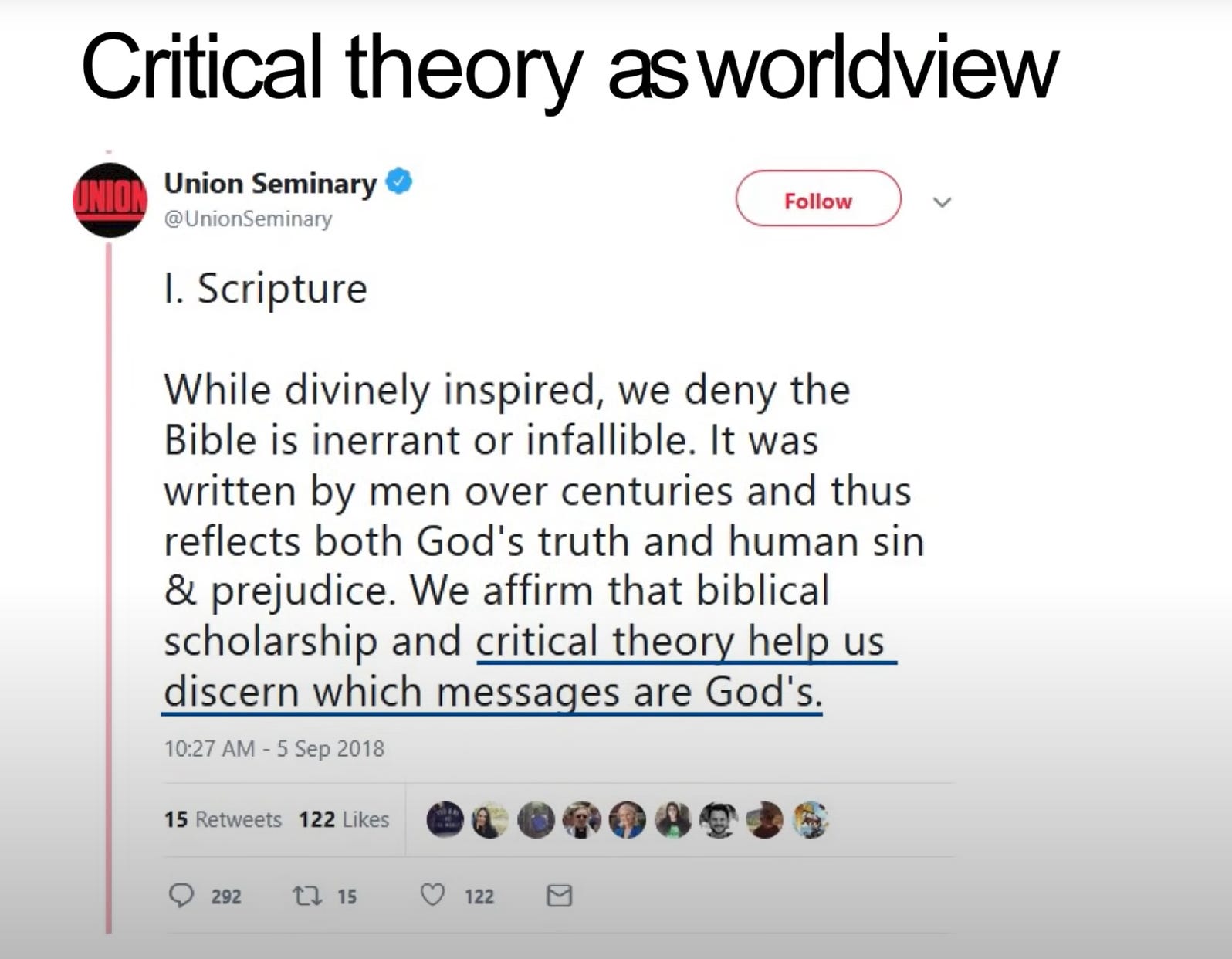
They are saying that Critical Theory is the lens from which we view everything INCLUDING THE BIBLE. During my research, a few people defined postmodernism as the negation of grand narratives and singular universal truths which Christianity most definitely is. Again herein lies a big problem which is that too many people are not just adopting some of these beliefs as a part of their politics. They are making it their worldview. Dare I say - a new religion. One that provides DIFFERENT answers to the following questions than Christianity does:
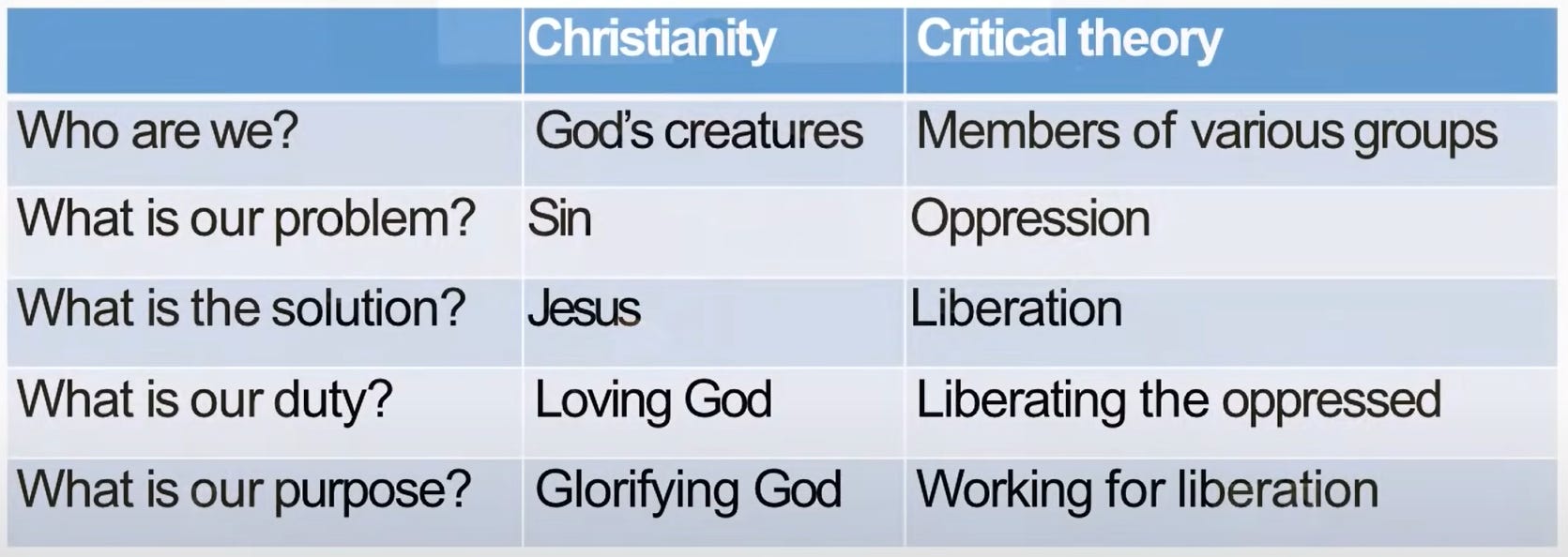
And this is a worldview (or religion) that has men in its cross-hairs.
Down With The Patriarchy!
So who is at the top of the hierarchy as oppressor that everyone should take aim at? You guessed it. The men. and the boys who are on a path towards it. There is vitriol towards them (especially the whites).
“Whiteness is wicked. It is rooted in violence, it’s rooted in theft, it’s rooted in plunder, it’s rooted in power, in privilege.” - Evalgenical Author
Sounds racist to me. But we’re sticking to gender today.
If you think of the classic iceberg picture - all of these beliefs and assumptions are below the surface and are manifesting themselves ways that are:
Generally deceptive
Demonizing men in our culture
Distorting what it means to be a man
The term “toxic masculinity” is a great example of this and stems from this ideology. Depending on how you define this term, it is true that there are bad men out there who are hurt, selfish, and believe in dangerous ideas about themselves and the world. As mentioned before, men throughout history have not always wielded their power and authority wisely and sacrificially. But to be clear, it’s also not true that being a man has not been all fun and games. Jordan Peterson provides a more accurate narrative of history here:
Narrative warfare is raging around this topic and aims to show how privileged men in particular have always been. I appreciate Jordan Peterson in this regard because he provides a much-needed voice in the discussion that most of history is better characterized as men and women working together against all odds to overcome and build the world that we have today. One that we are ALL privileged to take part in. Especially those in America.
Conclusion
Critical theory has taken us in a very wrong direction. It is a pendulum that has swung from one end to the opposite extreme surrounding gender and it’s time that we bring culture back to a salient and sound course embedding in the spiritual truth that God’s given in the nature of every man and woman.
And this is why we have Treign Up. There is a very narrow target to hit for biblical manhood. A standard that is very high. One that requires courage, selflessness, and perseverance. Following Christ as a man is the greatest call to adventure that exists. Nothing else will satisfy us. We hope to be a voice in this debate to:
Train - Encourage - Discipline our boys to be competent men with Christ-like character and fight against the deception and demonization that is pulling away men from the life God has designed them for.
By the way - much of the research done on this article was through Neil Shenvi’s work. I highly recommend you read more about what he has to say about this topic of critical theory!